Writing academic essays means researching existing materials, referencing published ideas, and organizing information into original content. Even careful writers can run into accidental plagiarism without proper rewriting techniques.
Many students struggle to rephrase source text naturally. Changing a few words here and there is not enough to create unique content, and it often leads to flagged duplicate content issues.
Manual paraphrasing takes hours of extra work. It slows down your writing process and leaves room for human error that can result in serious academic consequences.
Knowing how to use essay rewriter to avoid plagiarism correctly is a valuable skill for every student. When used properly, this tool transforms sourced content into unique, original writing while preserving core meaning.
This detailed guide explains common plagiarism risks, why basic rewriting fails, key tool features, real use cases, and a full step-by-step workflow to rewrite essays ethically and safely.
Understanding Plagiarism Risks in Essay Writing
Plagiarism goes beyond copying full paragraphs directly. It includes poorly rephrased text, uncredited ideas, and sentence structures that match existing published work.
Accidental paraphrasing mistakes
Most cases of academic plagiarism are not intentional. Writers keep the original sentence structure while swapping simple words, which detection tools still mark as duplicate content.
Over-reliance on source wording
After reading long research materials, it is easy to adopt the author’s exact phrasing. This habit carries over into your essay and creates unwanted similarities.
Time pressure leading to rushed edits
Tight deadlines push many learners to cut corners on rewriting. Quick surface-level changes never fully remove plagiarism risks from essays and papers.
Lack of professional paraphrasing skills
Rewriting complex academic language requires practice. New writers often cannot restructure sentences or adjust tone while keeping the original message intact.
Mixed cited and uncited content
When combining direct quotes, summaries and rewritten text, it is easy to blur lines. This confusion causes plagiarism flags even when you follow basic citation rules.
Why Manual Rewriting Alone Cannot Stop Plagiarism
Before learning how to use essay rewriter to avoid plagiarism, it helps to see the limits of doing all paraphrasing work by hand.
Limited structural changes
Most manual rewrites only replace synonyms. Advanced plagiarism checkers analyze full sentence flow, grammar patterns and paragraph order, catching these small changes easily.
Inconsistent rewriting quality
Your focus fades during long writing sessions. Later sections of your essay may have far more copied structure than earlier parts, creating uneven uniqueness.
High time investment
Fully rewriting a long research essay manually can take multiple hours. This takes valuable time away from refining arguments, adding analysis and checking citations.
Easy loss of original meaning
Trying to rephrase complicated academic ideas by hand often distorts key points. You may change the author’s intent while trying to avoid duplicate content.
No built-in duplicate detection
You cannot compare your rewritten text against online databases manually. You will not know if content is unique until you run a separate plagiarism scan later.
Core Benefits of Using Essay Rewriter to Avoid Plagiarism
Mastering how to use essay rewriter to avoid plagiarism gives you a reliable, efficient way to create original essays while respecting source material.
Deep structural paraphrasing
Quality essay rewriters restructure full sentences, rearrange clauses and adjust paragraph flow. These deep changes beat standard plagiarism detection systems fairly.
Preserves original research meaning
Top tools keep core ideas, data points and academic terminology intact. You get unique text without twisting the message from your research sources.
Cuts down total writing time
Rewriting entire sections takes seconds instead of hours. You can focus more on critical thinking, analysis and proper citation for your academic work.
Delivers consistent uniqueness
The tool applies the same rewriting standards across every paragraph. Your whole essay maintains a uniform level of originality from start to finish.
Supports formal academic tone
Good essay rewriters keep language formal and scholarly. They avoid casual phrasing that would make your paper sound unprofessional for school submissions.
Works for all essay lengths
Whether you are working on a short class essay or a long research paper, the tool handles full documents without losing quality or accuracy.
Key Features to Look for in a Reliable Essay Rewriter
Not all rewriting tools work well for academic tasks. To safely use an essay rewriter and avoid plagiarism, choose a tool with these essential functions.
Advanced sentence restructuring
Basic tools only swap words. A strong essay rewriter rearranges sentence order, splits long lines and combines short phrases for full content transformation.
Academic writing mode
Dedicated academic settings maintain formal style, technical terms and scholarly vocabulary. This prevents your essay from sounding too simple or conversational.
Selective word replacement
The tool should keep important terms, names, statistics and field-specific jargon unchanged. Random word swaps can ruin the accuracy of research-based essays.
Multiple rewriting levels
Look for light, medium and deep rewrite modes. Light edits work for minor tweaks, while deep rewrites create heavily unique content for high-risk plagiarism sections.
Full paragraph rewriting support
It should process large blocks of text at once. Rewriting paragraph by paragraph saves time and keeps logical flow between connected ideas.
Readability preservation
Some cheap rewriters create awkward, broken sentences. Premium options ensure rewritten text reads naturally for teachers, professors and review boards.
Common Academic Use Cases for Essay Rewriter Tools
Once you learn how to use essay rewriter to avoid plagiarism, you can apply this method to nearly every type of school writing assignment.
Class essay and homework assignments
Students use the tool to rephrase researched content for regular class essays. It removes duplicate content while keeping answers clear and on-topic.
Research paper content summarization
When summarizing journal articles or books, rewriting tools turn long source text into concise, unique summaries free of plagiarism.
Literature review writing
Literature reviews rely heavily on existing studies. Ethical rewriting helps you discuss published work in your own original voice.
Term paper and long project rewriting
Long term papers include dozens of sourced sections. A reliable rewriter ensures every part stays unique throughout the full document.
Revision of old essays
When reusing past research or updating old papers, rewrite existing text to avoid self-plagiarism for new submissions.
Group project and shared content editing
For group assignments, rewrite shared research notes so each member submits fully original personal sections.
Step-by-Step Guide: How to Use Essay Rewriter to Avoid Plagiarism
Follow this ethical, academic-friendly workflow to rewrite content properly, lower plagiarism risks and produce original essays every time.
Step 1: Gather and organize your source material
Collect all research paragraphs, quotes and reference text you plan to use in your essay. Separate direct quotes from content you want to paraphrase.
Mark key data, technical terms and author names that must stay unchanged during rewriting.
Step 2: Draft initial content from sources
Write rough notes or copy relevant sections from your research. Do not worry about uniqueness at this stage; focus on collecting all required information.
Keep direct quotation marks around any lines you plan to cite word-for-word in the final essay.
Step 3: Select text for rewriting
Highlight and copy only the content that needs paraphrasing. Exclude properly formatted quotes, citations and reference lines.
Work in small to medium paragraph chunks. Rewriting one huge block at once can disrupt logical flow and argument structure.
Step 4: Open your essay rewriter tool
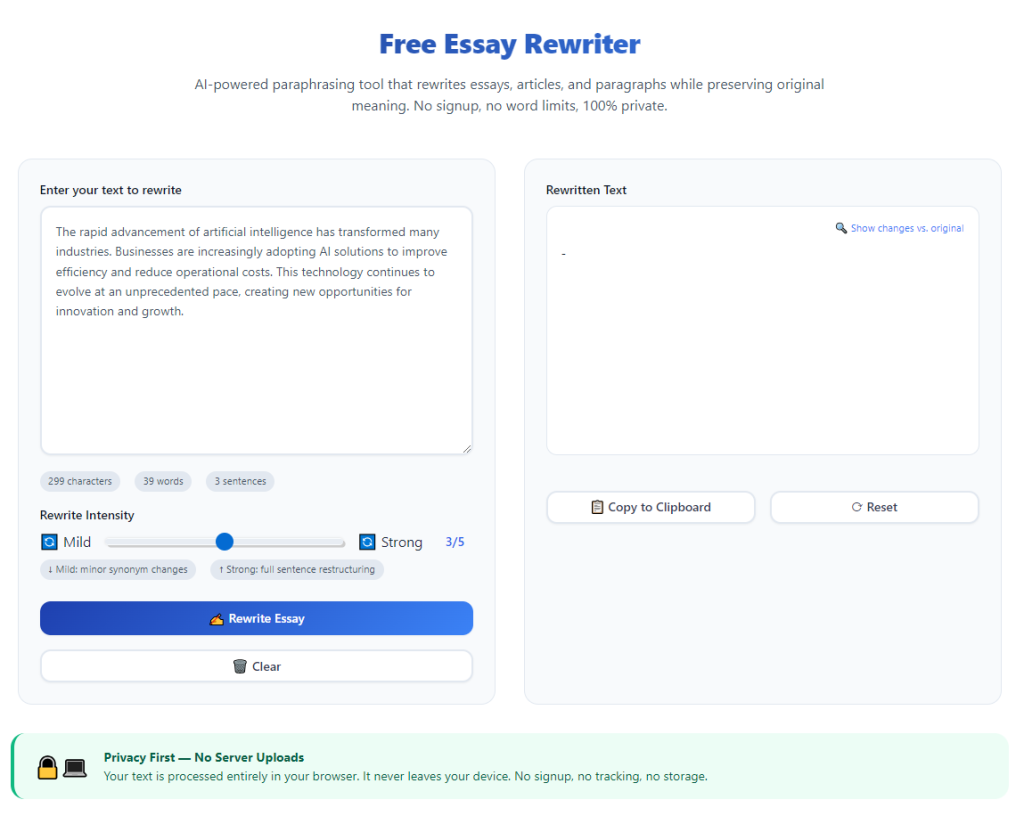
Launch the tool and locate the main text input area. Review available modes, including standard rewrite and academic rewrite settings.
Choose the academic mode first. This setting is optimized for essays, papers and formal school writing.
Step 5: Paste text and choose rewrite intensity
Paste your selected text into the input box. For high plagiarism prevention, select medium or deep rewrite level.
Use light rewrite only for minor phrasing fixes on content you already reworked manually.
Step 6: Start the rewriting process
Click the rewrite button and wait a few seconds. The tool will restructure sentences, adjust wording and create a new version of your text.
Read the new text fully to confirm it still matches the original meaning from your research sources.
Step 7: Make manual human edits
Automated rewriting is not a final step. Tweak awkward phrasing, fix small grammar issues and adjust tone to match your personal writing style.
Rearrange small sections if the paragraph flow feels off. This human touch adds extra originality and natural voice.
Step 8: Add proper citations and attributions
Even fully rewritten ideas still need citations. Add in-text citations for all concepts sourced from external authors and studies.
Follow your school’s formatting rules for references, works cited or bibliography sections.
Step 9: Repeat for all essay sections
Continue the same process for every researched paragraph in your essay. Keep your rewrite settings consistent for uniform tone.
Avoid rewriting full essays in one single batch. Working section by section maintains strong logical arguments.
Step 10: Run a full plagiarism check
Once your complete essay is finished, use a trusted plagiarism scanner to review the entire document.
Address any remaining flagged sections by rewriting those parts again with a deeper rewrite setting.
Step 11: Final review and submission
Read the full essay one last time for flow, grammar and consistency. Confirm all citations are correctly placed.
Your content is now unique, original and safe to submit with minimal plagiarism risk.
Common Mistakes to Avoid When Using Essay Rewriter
Even when you know how to use essay rewriter to avoid plagiarism, these common errors can still lead to problems and academic penalties.
Using rewriting tools for direct quotes
Never rewrite quoted text. Direct quotes should stay exactly as the original author wrote them and always include full citation marks.
Skipping manual human editing
Submitting raw automated rewrite output often results in choppy sentences and unnatural wording. Always edit after using the tool.
Overusing deep rewrite on technical content
Deep rewriting can alter complex academic definitions or formulas. Use lighter modes for content with strict technical meaning.
Forgetting to add citations after rewriting
Rewriting does not turn someone else’s ideas into your own. Missing citations remain a serious form of plagiarism.
Rewriting the entire essay at once
Full-document bulk rewrites break logical flow. Work section by section to keep your argument clear and organized.
Relying only on word-swap tools
Basic synonym changers do not beat modern plagiarism scanners. Always use a tool that restructures full sentences.
Pro Tips for Safe and Effective Essay Rewriting
Use these expert strategies to master how to use essay rewriter to avoid plagiarism and build better long-term writing habits.
- Read your source material fully first, then write ideas in your own words before running the rewrite tool.
- Mix rewrite modes across different sections to create more unique variation throughout your essay.
- Keep a list of key academic terms to ensure the tool does not replace essential vocabulary during paraphrasing.
- Combine rewritten content with your own analysis and opinions to add original value to every paragraph.
- Run a plagiarism check after every major rewrite session to catch issues early, before final submission.
- Use the tool as a learning aid. Compare original and rewritten text to improve your manual paraphrasing skills over time.
- Follow your institution’s academic guidelines for paraphrasing to stay compliant with all school rules.
Final Thoughts
Plagiarism is one of the most serious concerns for every student working on essays and research papers. Accidental duplication can damage grades and academic standing.
Manual paraphrasing is slow, inconsistent and prone to error. Basic word swapping no longer works against modern plagiarism detection technology.
Learning how to use essay rewriter to avoid plagiarism the right way gives you a fast, practical solution for ethical academic writing.
A quality essay rewriter restructures content deeply, preserves original meaning and maintains formal academic tone. When paired with manual edits and proper citations, it creates fully original work.
This tool is meant to support your writing process, not replace your critical thinking and research. Used responsibly, it saves time and helps you submit clean, plagiarism-free essays every single time.
By following this complete guide and avoiding common mistakes, you can use essay rewriters confidently, produce unique content, and focus on growing your academic writing skills.
After learning the operation method, click the link below to enter the tool page for immediate use.