Let’s be real—merging PDFs sounds easy, but it’s always a nightmare. You’ve got a bunch of PDF files—maybe a research paper, a few images, and a cover page—and you need to combine them into one. So you grab a random tool, upload your files, hit “merge,” and… ugh. The text is blurry, the images are distorted, and the formatting is all messed up. All that hard work you put into making your PDF look professional? Wasted.
And the worst part? Most tools out there promise “quality loss-free” merging, but they lie. They compress your files to save space, ruining your high-res images, crisp text, and carefully set formatting[2][8]. Whether you’re a student submitting an assignment, a professional sending a report, or someone just organizing personal files, you need a tool that keeps your PDFs looking exactly like the original. That’s where the best tool to merge PDF without quality loss comes in.
I’ve tested dozens of PDF merging tools—some free, some paid—and I’ve learned the hard way which ones actually deliver on their “no quality loss” promise. In this guide, I’m going to walk you through everything you need to know about the best tool to merge PDF without quality loss: how to pick it, how to use it step by step, common mistakes to avoid, and pro tips to make merging PDFs a breeze. I’ll keep it casual, no tech jargon, and focus on real-life scenarios—because let’s be honest, we’re all just trying to get things done without extra hassle. By the end, you’ll know exactly how to merge PDFs without losing a single bit of quality.
Why You Need the Best Tool To Merge PDF Without Quality Loss (It’s Not Just About “Crispness”)
First, let’s talk about why quality loss matters when merging PDFs. It’s not just about making your files look pretty—though that’s a big part of it. Here’s why you absolutely need thebest tool to merge PDF without quality loss:
• Preserve images and text clarity: If your PDFs have high-res images (like graphs, photos, or diagrams), a bad tool will compress them, making them blurry or pixelated[2][6]. The best tool keeps every detail sharp, so your images and text look just like the original.
• Keep formatting intact: Ever merged PDFs and found that the font changed, margins shifted, or pages were cut off? That’s quality loss too[8]. The best tool to merge PDF without quality loss preserves your original formatting—margins, fonts, spacing, and all.
• Maintain professional standards: For students, professionals, or anyone sharing important documents, blurry PDFs look unprofessional[5][6]. Using the best tool ensures your merged PDF is polished and trustworthy—perfect for assignments, reports, contracts, or portfolios.
• Avoid redoing work: There’s nothing more frustrating than merging PDFs, realizing the quality is ruined, and having to start over[8]. The best tool to merge PDF without quality loss saves you time and stress by getting it right the first time.
• Works for all file types: Whether you’re merging PDFs with text, images, tables, or even scanned pages, the best tool handles them all without quality loss[4][7]. No more worrying about certain files getting messed up.
Pro tip: I once merged a portfolio of my design work using a cheap tool, and all my high-res images turned blurry. I had to re-merge everything with a better tool, and it cost me hours of time. Don’t make the same mistake—I’m here to show you the best tool to merge PDF without quality loss, so you can avoid that headache.
How to Pick the Best Tool To Merge PDF Without Quality Loss (Avoid the Duds!)
Not all PDF merging tools are created equal—most claim to be “quality loss-free,” but only a few actually deliver[2][8]. Before we dive into how to use the tool, let’s make sure you pick the right one. Here’s what to look for (learn from my trial-and-error!):
1. Explicitly says “no quality loss” or “lossless merging”: Don’t trust tools that just say “high quality”—look for ones that specifically promise no quality loss or lossless merging[2][6]. This means they won’t compress your files or alter your original content.
2. Free (no sign-up, no hidden fees): You don’t need to pay to merge PDFs without quality loss. The best tool to merge PDF without quality loss is 100% free, no email required, no limits on how many files you can merge[1][4].
3. Easy to use (no complicated steps): The best tool should be simple—drag and drop your files, reorder if needed, and click “merge.” No downloads, no software installation, no tech skills required[1][9].
4. Secure: If you’re merging sensitive files (like contracts, medical records, or personal documents), the tool should keep your files safe[4][8]. Look for tools that encrypt your files during upload and delete them after merging—no storing your data.
5. Supports multiple files and large sizes: It should handle more than just 2-3 files—look for tools that let you merge up to 100 files at once, and support large file sizes (so you don’t have to split your merge into multiple rounds)[1][4].
6. Works on any device: You might merge PDFs on your laptop at home, or on your phone while you’re out. The best tool to merge PDF without quality loss is mobile-friendly, working on phones, tablets, and desktops[1][4].
7. Let’s you reorder pages: Sometimes you need to rearrange your PDFs before merging—look for tools that let you drag and drop files to change the order, or even delete pages you don’t need[1][7].
Step-by-Step: How to Use the Best Tool To Merge PDF Without Quality Loss (In 5 Simple Steps)
Now that you know how to pick the best tool to merge PDF without quality loss, let’s walk through how to use it. These steps work for any top-tier free tool, and they’re designed to be quick and easy—you’ll be done in under a minute, even with multiple files. I’ll use real examples so you can follow along.
Step 1: Prepare Your PDF Files (Organize First!) – Save Time Later
Before you even open the tool, take 30 seconds to organize your PDF files. This will save you time and ensure your merged PDF is in the right order[8]. Here’s what to do:
• Gather all the PDFs you want to merge into one folder (on your computer or phone). This way, you can find them easily.
• Rename them if needed to reflect the order you want (e.g., “1-Cover Page.pdf,” “2-Research.pdf,” “3-Images.pdf”). This helps you avoid mixing up the order later[8].
• Double-check that you have the final versions of your files—nothing worse than merging a draft by accident[8]!
Example: If you’re a student merging an essay, you might have “1-Cover.pdf,” “2-Essay Body.pdf,” “3-References.pdf,” and “4-Appendix.pdf.” Organizing them first ensures they merge in the correct order.
Step 2: Open the Best Tool To Merge PDF Without Quality Loss
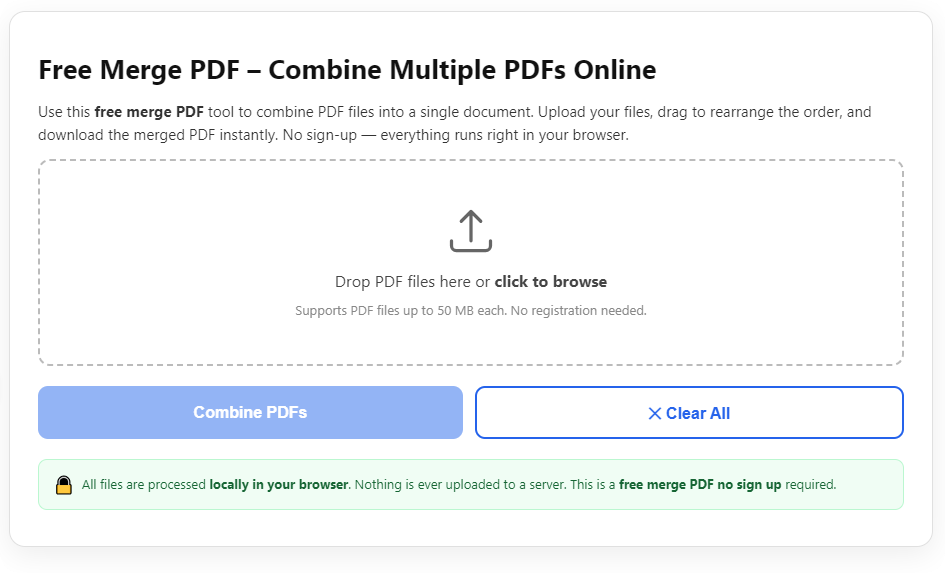
Open your browser and go to the tool (remember, no downloads needed—just a web browser like Chrome, Safari, or Edge[1][9]). You’ll see a simple interface with a text box that says something like “Drag and drop your PDF files here” or “Select files to merge.”
Pro tip: Bookmark the tool so you can access it quickly next time—no more searching for “free PDF merger” every time you need to merge files[1][4].
Step 3: Upload Your PDF Files (Drag & Drop Is Easiest!)
Now it’s time to upload your PDFs. The best tool to merge PDF without quality loss makes this super easy—here’s how:
• Drag and drop: Click and hold your PDF files (one by one or all at once) and drag them into the tool’s upload zone[1][4]. This is the fastest way.
• Select files manually: If drag and drop doesn’t work (e.g., on a phone), click the “Select files” button, navigate to your folder, and choose the PDFs you want to merge[1][9].
What to expect: Once you upload the files, they’ll appear as thumbnails in the tool. You’ll see the name of each file, and sometimes a preview of the first page[4][7].
Pro tip: Don’t worry about file size—if you’re using the best tool to merge PDF without quality loss, it can handle large files without compressing them[4][6].
Step 4: Reorder Your Files (If Needed) – Get the Sequence Right
This is a crucial step—don’t skip it! The tool will merge your files in the order they appear in the upload zone. If they’re out of order, your merged PDF will be a mess[8]. Here’s how to fix it:
• Click and hold a file thumbnail, then drag it up or down to move it to the correct position[1][7].
• If you uploaded a file by mistake, look for a “Delete” or “X” button next to the thumbnail to remove it[4][7].
• Some tools let you expand each PDF to reorder individual pages (e.g., if you want to move a page from one PDF to another)[7][9]. This is helpful if you need to tweak the layout even more.
Example: If you uploaded “3-References.pdf” before “2-Essay Body.pdf,” just drag “2-Essay Body.pdf” above “3-References.pdf” to fix the order.
Step 5: Merge & Download Your Quality-Loss-Free PDF
You’re almost done! Once your files are in the right order, it’s time to merge them. Here’s how:
1. Look for a button that says “Merge PDFs,” “Combine Files,” or “Start Merging”—click it[1][9].
2. Wait a few seconds (the time depends on how many files you’re merging—even 100 files only take a minute or two)[1][4].
3. Once the merge is done, the tool will show a “Download” button. Click it, and your merged PDF will download to your device[1][9].
4. Double-check the merged PDF: Open the downloaded file and make sure the quality is intact—text is crisp, images are clear, and the order is correct[3][8]. If everything looks good, you’re done!
Pro tip: If you need to share the merged PDF, most tools let you generate a shareable link (no need to download and email it)[1][9]. Just click “Share” and copy the link to send to your professor, boss, or friend.
Real-Life Scenarios: Using the Best Tool To Merge PDF Without Quality Loss
Let’s put these steps into action with real scenarios you’ll actually encounter. This will show you just how useful thebest tool to merge PDF without quality loss is in everyday life.
Scenario 1: Student Merging Assignment Materials
You’re a student, and you need to submit an assignment that includes a cover page, essay body, references, and a graph (all separate PDFs). You don’t want the graph to get blurry or the references to be out of order. Here’s how to use the tool:
1. Organize your files: “1-Cover.pdf,” “2-Essay.pdf,” “3-Graph.pdf,” “4-References.pdf.”
2. Open the best tool to merge PDF without quality loss, drag and drop all four files.
3. Reorder them to make sure they’re in the correct sequence (they should be, since you named them numerically).
4. Click “Merge PDFs” and wait a few seconds.
5. Download the merged PDF, open it, and check that the graph is crisp and the formatting is intact. Submit it to your professor—no quality loss, no stress[5][6].
Scenario 2: Professional Merging Work Reports
You’re a professional, and you need to merge three work reports (each with high-res charts) into one PDF to send to your boss. You need the charts to stay clear and the formatting to match across all reports. Here’s how:
1. Gather the three report PDFs and organize them in the order your boss wants to read them.
2. Upload them to the tool, reorder if needed.
3. Merge the files—since it’s the best tool to merge PDF without quality loss, the charts stay sharp and the formatting is consistent[4][8].
4. Download the merged PDF, double-check, and email it to your boss. They’ll be impressed by the professional, high-quality result[6][7].
Scenario 3: Organizing Personal Files (E-Books, Invoices)
You have a bunch of PDF invoices from the past year, and you want to merge them into one file for easy storage. You don’t want the text (like dates and amounts) to get blurry. Here’s how:
1. Organize the invoices by date (oldest to newest).
2. Upload them to the tool, reorder if any are out of place.
3. Merge and download—your invoices are now in one file, with all text and details crisp and easy to read[2][6].
Scenario 4: Merging Scanned PDFs (Photos, Documents)
You scanned a few old photos and documents into PDFs, and you want to merge them into a single portfolio. You need the scanned images to stay clear (no blurriness). Here’s how:
1. Upload the scanned PDFs to the tool.
2. Reorder them to the desired sequence.
3. Merge and download—the best tool to merge PDF without quality loss preserves the scan quality, so your photos and documents look just like the original[2][4].
Common Mistakes People Make When Using the Best Tool To Merge PDF Without Quality Loss
I’ve made every single one of these mistakes, so learn from me! Even if you’re using the best tool to merge PDF without quality loss, these errors can ruin your merged file:
1. Not organizing files first: Uploading files in the wrong order means you’ll have to reorder them in the tool—and it’s easy to mix up[8]. Take 30 seconds to organize them first.
2. Uploading non-PDF files: The tool only merges PDFs—if you upload a Word or JPG file, it might convert it to PDF but lose quality[4][6]. Convert non-PDF files to PDF first (use a free converter) before merging.
3. Ignoring the preview: Don’t just click “merge” and download—preview the merged file first to make sure the order is right and quality is intact[3][8].
4. Using a tool that’s not “lossless”: Even if you follow all steps, using a bad tool will still result in quality loss[2][8]. Make sure you’re using the best tool to merge PDF without quality loss (check the features we talked about earlier).
5. Merging too many files at once (for small tools): While the best tool can handle 100+ files, some cheap tools struggle with more than 5-10 files[1][4]. If you have a lot of files, merge them in rounds (merge 10, then merge that result with the next 10).
6. Forgetting to download the merged file: Some tools delete your files after a few hours—download it right away to avoid losing it[4][8].
Pro Tips to Get the Most Out of the Best Tool To Merge PDF Without Quality Loss
Now that you know how to use the best tool to merge PDF without quality loss, these pro tips will help you make the most of it—saving time and ensuring perfect results every time:
1. Bookmark the tool: As I mentioned earlier, bookmarking it saves you time from searching for it every time you need to merge PDFs[1][4].
2. Convert non-PDF files to PDF first: If you have Word, Excel, or image files, convert them to PDF using a free converter before merging—this ensures no quality loss[4][6].
3. Compress (if needed) after merging: If your merged PDF is too large to email, use a free PDF compressor (make sure it’s also lossless!) to reduce the size without ruining quality[8].
4. Use the “delete page” feature: If a PDF has extra pages you don’t need (e.g., a blank page at the end), use the tool’s delete feature to remove it before merging[7][9].
5. Test with a small batch first: If you’re merging a lot of important files, test the tool with 2-3 small PDFs first to make sure it works[3][8].
6. Share via link instead of email: If the merged PDF is large, use the tool’s shareable link feature to send it—this avoids email size limits and keeps the quality intact[1][9].
7. Use it for all your merging needs: Whether it’s school, work, or personal files, the best tool to merge PDF without quality loss works for every scenario[5][6].
Frequently Asked Questions (FAQ) – About the Best Tool To Merge PDF Without Quality Loss
Q: Is the best tool to merge PDF without quality loss really free? A: Yes! The best ones are 100% free, no sign-up, no hidden fees, no limits on how many files you can merge or how many times you use it[1][4].
Q: Do I need to download software to use it? A: No! The best tool to merge PDF without quality loss is online—just use your web browser (Chrome, Safari, Edge, etc.). No downloads, no installation, no storage space used[1][9].
Q: Will it keep my images and text crisp? A: Absolutely! That’s the whole point of the best tool to merge PDF without quality loss—it doesn’t compress your files, so images stay high-res and text stays sharp[2][6].
Q: Can I merge more than 2 PDFs at once? A: Yes! Most top tools let you merge up to 100 PDFs at once, and some even more[1][4]. You don’t have to merge them one by one.
Q: Is it safe to use for sensitive files? A: Yes—if you pick the right tool. The best tool to merge PDF without quality loss encrypts your files during upload and deletes them after merging, so no one else can access them[4][8].
Q: Can I use it on my phone? A: Yes! The best tool to merge PDF without quality loss is mobile-friendly, so you can merge PDFs on your phone, tablet, or laptop—anywhere, anytime[1][4].
Q: What if I don’t like the merged result? A: Just re-upload your files, reorder if needed, and merge again—it’s free and takes only a few seconds[1][9].
Final Thoughts – The Best Tool To Merge PDF Without Quality Loss Is a Lifesaver
Merging PDFs shouldn’t be a hassle, and it definitely shouldn’t ruin the quality of your hard work. The best tool to merge PDF without quality loss takes the stress out of merging— it’s free, easy to use, and keeps your files looking exactly like the original[1][8]. Whether you’re a student, a professional, or just someone organizing personal files, this tool is a must-have.
The key takeaway? Stop wasting time on tools that promise “quality loss-free” merging but deliver blurry, messed-up files. The best tool to merge PDF without quality loss does what it says—no tricks, no hidden fees, no stress. It’s simple: organize your files, upload, reorder, merge, and download. That’s it.
I’ve used this tool for years, and it’s saved me countless hours of redoing work and stressing about quality. It’s perfect for assignments, reports, portfolios, invoices, and more. Once you use it, you’ll wonder how you ever merged PDFs without it.
So next time you need to merge PDFs, don’t settle for a tool that ruins your quality. Use the best tool to merge PDF without quality loss—you’ll get crisp, professional results in minutes, and you’ll never look back. Start merging now, and say goodbye to blurry PDFs forever!
After learning the operation method, click the link below to enter the tool page for immediate use.